

CG Policy · 2025
In this section7 topics
Corporate Governance Policy
Introduction
The Company has a corporate governance policy and Code of Business Conduct, which has been updated to be consistent in writing. The Stakeholders can see the full details on the Company’s website www.goldenlime.co.th click Sustainability, Click Economy, Click Good Corporate Governance. URL: URL: https://goldenlime.co.th/en/corporate_governance/ selected download Corporate Governance Policy (P.20-P.41)
In 2025, SUTHA disclosed an annual report via the Data Platform designed for reporting corporate governance performance of listed companies. This system integrates policies related to the board, executives, and management, ensuring compliance with legal standards and business ethics, as established by the Stock Exchange of Thailand.
The eOne Report SET system will facilitate the aggregation and disclosure of these policies, enabling effective communication with stakeholders. This initiative keeps stakeholders informed about corporate governance details through the 56-1 One Report, as outlined by the Stock Exchange of Thailand.
Has a Corporate Governance Policy
Yes
Policy Description
The Company has a corporate governance policy and Code of Business Conduct, which has been updated to be consistent in writing. The Stakeholders can see the full details on the Company’s website www.goldenlime.co.th click Sustainability, Click Economy, Click Good Corporate Governance.
In 2025, the Board of Directors held on 21 February 2025 has been approved the corporate governance policy for the 6th revision that this the latest version applies to use the Corporate Governance Code for listed companies in 2017 (“CG Code 2017”) publisher from Securities and Exchange Commission, Thailand (the SEC) apply to determine the corporate governance of the Company based
on the main guidelines of CG Code 2017 to adjust with appropriate in line for the Company’s business operation. The Good CG Code principles are as follow;
Principle 1: Establish clear leadership role and responsibilities of the board
Principle 2: Define objectives that promote sustainable value creation
Principle 3: Strengthen board effectiveness
Principle 4: Ensure effective CEO and people management
Principle 5: Nurture innovation and responsible business
Principle 6: Strengthen effective risk management and internal control
Principle 7: Ensure disclosure and financial integrity
Principle 8: Ensure engagement and communication with shareholders
All above 8 principles are disclosed in detail on the website and established as a corporate policy called “ESG, sustainability development and business ethics “ which consists of policies and guidelines for implementing the corporate governance :
Key engagement in corporate governance
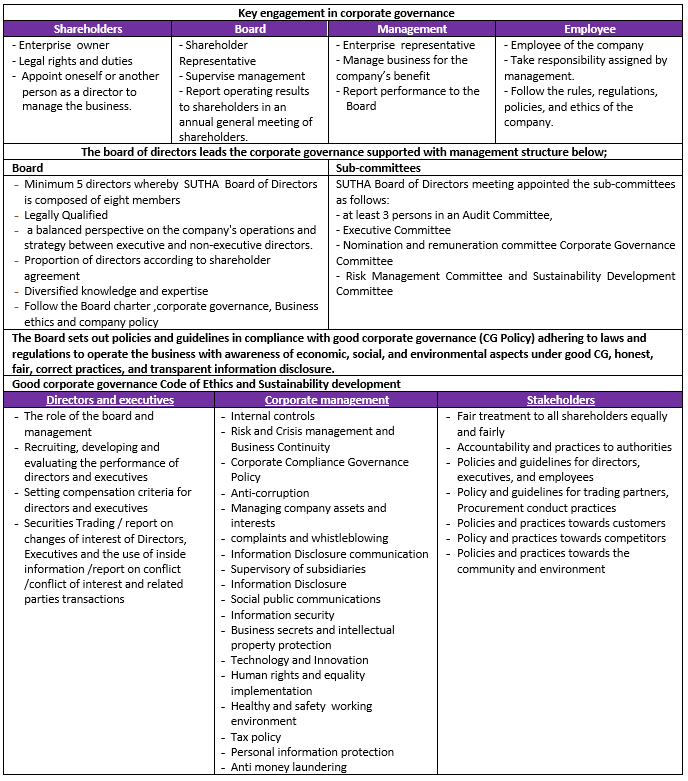
The details of these principles are outlined in "Good Corporate Governance, Business Ethics, Sustainability Business Development, and Social and Environmental Responsibility," along with additional policies on the Company's website.
Policy Document Link
https://goldenlime.co.th/en/corporate_governance/
Page Number in Report
21-41
Policy & Practices — Board of Directors
Has Policy & Guidelines for the Board
Yes
Board Guidelines
| Guideline | Detail | Document Link | Page Number in Report |
|---|---|---|---|
| Nomination of Directors | Principle The board should ensure that a proper mechanism is in place for the nomination and development of the chief executive officer and key executives to ensure that they possess the knowledge, skills, experience, and characteristics necessary for the Company to achieve its objectives. Guidelines 1. The board should establish, or assign the nomination committee to establish, the criteria and procedures for nomination and appointment of a qualified person as the chief executive officer. If the nomination committee is not appointed, the board shall collaboratively consider and perform the role of the nomination committee.
2. The board should ensure that the chief executive officer appoints knowledgeable, skilled, and experienced key executives. The board or the nomination committee together with the chief executive officer should establish the criteria and procedures for nomination and appointment of key executives.
3. To ensure business continuity, the board should ensure that development and succession plans for the chief executive officer and key executives are in place. The board should annually request reporting on the implementation of the development and succession plans from the chief executive officer.
4. The board should promote continuous development and education of the chief executive officer and key executives that is relevant to their roles.
5. The board should establish set clear policies and guidelines for the chief executive officer and key executives serving or wishing to serve as a director in other companies. The policies should set out permissible appointments and the permissible number of companies in which they are allowed to simultaneously serve as a director. | https://www.goldenlime.co.th/pdf/Corporate_Governance_Policy_2025_EN.pdf | 31-33 |
| Determination of Director Remuneration | Compensation for directors Principle Pursuant to the Section 90 of the Public Limited Companies Act, B.E. 2535. “The company shall not pay money or give any property to a director, unless it is a payment of remuneration under the articles of association of the company. In the case where the articles of association of the company is not stipulated, the payment of remuneration under paragraph one shall be in accordance with the resolution of the meeting of shareholders based on a vote of not less than two thirds of the total number of votes of the shareholders attending the meeting.” Article 22 ARTICLES OF ASSOCIATION The Company’s Directors are entitled to remuneration from the Company in the form of reward, meeting allowance, gratuity, bonus or other kinds of benefit as considered and approved by the shareholders meeting with the votes of not less than two-thirds (2/3) of the total shareholders attending the meeting. Such remuneration may be fixed in an exact amount or by a specific principle and may be fixed from time to time or perpetually until the shareholders meeting will resolve to change in otherwise. In addition, the Company’s Directors is entitled to allowance and welfare pursuant to the Company’s regulations. The provision in Paragraph one shall not affect the rights of the directors appointed from the Company’s employees or staff who is entitled to the remuneration and benefits as the Company’s employees or staff. The Board of Directors is to propose a fair and appropriate remuneration to each director and executive of the Company based on market conditions, business competition, nature of business, operating results, the Company’s financial standing as well as responsibilities, duties, and performance of each director and executive. The director who also performs the duty as an Audit Committee member will also receive the allowance of the Audit Committee. The director who also performs the duty as a member of the Nomination Remuneration and Corporate Governance Committee will also receive the allowance of the Nomination Remuneration and Corporate Governance Committee. However, the remuneration for the directors shall be approved by the Shareholders meeting and the remuneration of the Executives shall be approved by the Board of Directors meeting. 1) Yearly remuneration 2) Board of Director Meeting Allowance 3) Audit Committee Meeting Allowance 4) Nomination Remuneration and Corporate Governances Committee Meeting 5) Bonus which is considered as per proposed by the Nomination and Remuneration Committee to the Board of Directors under the amount approved by the shareholders' meeting. Guidelines 1) Directors' remuneration must be approved by the company's shareholder meeting. 2) The remuneration of directors is proposed to the Nomination and Remuneration Committee then the board must review the proposal before presenting it to the annual general shareholders' meeting for approval. 3) Remuneration depends on each director’s responsibilities, duties, performance added with attendance fee ; Board meetings, Audit Committee Meeting , NRCG meeting with fixed rate paid to the Chairman and each director. 4) Director who have been holding office for less than one year, his remuneration is based on the office period in the year. 5) Bonus for directors based on the dividend payment not exceeding 0.5 percent of the estimated amount of dividends paid and not exceeding the amount approved by the shareholders' meeting. If no dividend payment is announced, no bonuses for directors in that year. 6) Remuneration shall follow what has been approved by AGM only without any other other additional privileges. 7) Any change shall be presented to the NRCG meeting then to the Board of Directors meeting and proposed to the shareholder meeting accordingly. 8) The disclosure of each remuneration either individual or entire payment should be presented in the annual report via SET and the website of the company. Compensation of top executives and compensation of executives Principle The Company has set the remuneration to the Executives individual that shall receive appropriate remuneration, in consideration of their employment agreement as an individual contract and individual duties and responsibilities, knowledge and experience, as well as the executive's performance (KPI) in conjunction with the company's overall operational performance, according to the remuneration policy. Moreover, the assessment of economic prospects and the Company's plans are also used for determining remuneration for the executives. Remuneration adjustment depends on overall operating results of the company, annual salary increases, each executive’s performance and economic trends and the company’s plan. Guidelines 1) Remuneration for the top executive relates to the main shareholder in the case that such executive nominated by that shareholder, with the pay rate in accordance with the agreed employment contract with the shareholder. 2) The Company discloses the total directors’ remuneration and executives’ remuneration to the NRCG and Board meeting to be disclosed in the annual report. Compensation or other non-monetary benefits for directors and executives Principle In addition to paying remuneration to Directors and Executives in monetary terms, the Company also has to pay compensation or other non-monetary benefits which will either be or not be accounted as income of Directors or Executives as follows; Guidelines 1) Director & Officers Liability Insurance of Directors and Executives of the Company and subsidiaries, and compensation for the Company (Directors and Officers' Liability Insurance (D&O)) with protection Directors and Executives for managerial liability, careless/unintentional whether it was actually done/claimed to have been done with primary protection. (financial damage and limited litigation expenses according to annual insurance policy) 2) Insurance for protection of life and health of the highest management according to conditions that are in accordance with the employment contract. 3) Accommodation fees, medical expenses, tuition fees for children that are paid in the top management according to the conditions agreed with the individual employment contract. 4) Cars for high-level Executives in certain positions which are in accordance with the policy of the Company or subsidiary. The Company is responsible for inspection fee, repair fee, car registration, insurance fees, expressway fee, and all actual fuel costs or not exceeding the approved rate for each position. 5) Mobile phones and phone expenses, and internet service fees for some senior executives in accordance with the policy of the Company. The Company is responsible for the actual costs incurred or not exceeding the approved rate for each position. | https://www.goldenlime.co.th/pdf/Corporate_Governance_Policy_2025_EN.pdf | 72-74 |
| Independence of the Board of Directors from the Management | Establish Clear Leadership Role and Responsibilities of the Board Principle 1 The board should demonstrate a thorough understanding of its leadership role, assume its responsibilities in overseeing the Company, and strengthen good governance, including: (1) defining objectives; (2) determining means to attain the objectives; and (3) monitoring, evaluating, and reporting on performance. Guidelines 1. To consider and approve of the statement of vision, mission and cooperate values of the Company to ensure that they are effectively applicable and practical. 2. To consider and approve of the Company’s strategic plan, business direction, target, workforce structure, and other significant operations, including regularly monitoring and reviewing operation results to ensure that they are in line with the Company’s as planned. 3. To consider and approve of the overall operation and manage the budget for consider to allocate the significant of all resources that are in line with the Company’s as planned. 4. Consider to follow up and recognize the operation results as well as evaluate and oversee the performance of the management to be in line with the objectives, goals, and work plans. Principle 2 To achieve sustainable value creation, the board should exercise its leadership role and pursue the following governance outcomes: (1) competitiveness and performance with long-term perspective; (2) ethical and responsible business; (3) good corporate citizenship; and (4) corporate resilience. Guidelines 1. In evaluating the performance of the Company, the board should not just consider the Company’s financial results but also take into account non-financial performance such as its ethical performance and impact on stakeholders, society and the environment. The board should consider and approve policies on environmental management and social responsibility. 2. The board should assume a leadership role in creating and driving a culture of compliance and ethical conduct throughout the Company, and lead by example. The board should be the leader in implementing and following the guidelines of good corporate governance. 3. The board should ensure the creation of written policies and guidelines, such as a corporate governance policy, codes of ethics, and business conduct, applicable to all directors, executives, employees and staff of the Company. The board should arrange for creating and considering to approve policies of good corporate governance and business etiquettes, etc. 4. The board should ensure effective implementation including regular communication of the Company’s policies and guidelines to all directors, executives, employees and staff. The board should ensure adequate mechanisms are in place for monitoring, reviewing and reporting compliance with the Company’s policies and guidelines. Principle 3 The board should ensure that all directors and executives perform their responsibilities in compliance with their fiduciary duties, and that the Company operates in accordance with applicable law and standards. Guidelines 1. In assessing whether directors and executives have performed their fiduciary duties with the required responsibility, due care and loyalty, reference should be made to the applicable law and standards, including those contained in the Securities and Exchange Act of Thailand 1992. 2. The board is responsible for the implementation of adequate systems and controls to ensure that the Company complies with applicable law and standards for specified matters, including material investment, related party transaction, acquisition/disposal of assets, and dividend payment decisions. Principle 4 The board should demonstrate a thorough understanding of the division of board and management responsibilities. The board should clearly define the roles and responsibilities of management and monitor management’s proper performance of its duties. Guidelines 1. The board should adopt a written policy (such as a charter) that clearly sets out the roles and responsibilities of the board and management. The board should regularly review the policy. 2. The board is responsible and accountable for the overall affairs of the Company but may delegate day-to-day management duties. The board must provide written directions to management that clearly set out management’s responsibilities. Recommended division of board and management’s responsibilities: Matters for which the board has primary responsibility: 1) Defining objectives and business model. 2) Developing culture of compliance and ethical conduct, and lead by example. 3) Strengthening an effective board structure and practices conducive for achieving the Company’s objectives. 4) Ensuring suitable CEO selection, remuneration, development, and performance evaluation. 5) Ensuring appropriate compensation architecture that supports achievement of the Company’s objectives. Matters involving shared responsibility of the board and management: 1) Formulating and reviewing policies and strategies, plans and targets. 2) Ensuring robust system for risk management and internal control. 3) Clearly defining management’s responsibilities. 4) Overseeing appropriate policies and plans for resource allocation, including HR, IT, and budgeting. 5) Monitoring and evaluating financial and non-financial corporate performance. 6) Ensuring integrity of financial and non-financial information disclosures. Matters that the board should delegate or not get involved with: 1) Engaging in activities which under normal circumstances are not expected roles of the board, including day-to-day management and decisions (such as procurement and staffing), ongoing monitoring that conduct and operations are in compliance with the Company’s policies, strategies, plans, and applicable law and standards. 2) Not getting involved in or influencing matters in which a director may have vested interests. Explanation (1) Matters for which the board has primary responsibility are matters that the board should fully consider. Some matters may be decided following recommendation by management as appropriate. (2) Matters involving shared responsibility of the board and management are matters requiring joint consideration between the board and management. The board must closely monitor these matters and seek regular reports from management. (3) Matters that the board should delegate to management are matters in which the board should refrain from active involvement in normal circumstances. | https://www.goldenlime.co.th/pdf/Corporate_Governance_Policy_2025_EN.pdf | 23-24 |
| Director Development | Development Scheme for Directors and Executives The Board has a policy to promote and facilitate all directors in performing their duties including training and education for directors, executives and others relevant to the corporate governance system of the Company. Training courses from the Thai Institute of Directors Association (IOD), The stock exchange of Thailand (“SET”), The Securities and Exchange Commission, Thailand (“SEC”)), Thai Listed Companies Association (“TLCA”) and others are guided and provided for continuous performance improvement. The details of the training courses of each director are presented in the director’s profile. The foreign directors nominated by the major shareholder are knowledgeable and experienced in the duty as a director in the world's leading private companies and capable in the business management or industrial management that suit beneficially to the Company’s major business. Nominated director by a group of shareholders is qualified on the shareholders’ basis such as expertise, knowledge and experience to ensure its ability to perform their duties and provide useful recommendations to the company. The Managing Director and senior executives are presenting needful information to foreign directors in English or visit the link http://www.goldenlime.co.th/ir_index.asp?business including visiting the company's business and its subsidiaries on appropriate occasions. Director’s training in Thailand will be notified and arranged via online link as well as regulations by the Securities and Exchange Commission to be translated and disseminated for acknowledgement. Any training in English will be proposed to foreign directors with time zone limitation still. Training courses both by the Stock Exchange of Thailand and the Securities and Exchange Commission Will be notified to all directors for registration and participation. | https://www.goldenlime.co.th/pdf/Corporate_Governance_Policy_2025_EN.pdf | 71 |
| Board Performance Evaluation | The Board conducts the performance self-evaluation annually for further development and enhancement of their performance. The Boards can evaluate individual board directors or the whole board. Self-evaluations give boards a chance to address their weaknesses, analyze the issues and difficulties arising during last year and to increase the effectiveness of the Board's performance. The Company Secretary shall distribute an electronic annual performance evaluation form to all directors, wholly and individually. After completing the assessment, the directors shall return the evaluation forms to the Company secretary to establish a summary report to the board meeting. The criteria for self-assessment of the committee are as follows: 1) Self-Evaluation for the Board of Directors as a whole 2) Self-Assessment of individual Sub-Committee. 3) Self-Assessment of individual basis Criteria for the performance Self-evaluation of the Board of Directors: “Self-Evaluation for the Board of Directors as a whole” uses an evaluation guide to mark the assessment in order to evaluate the overall performance of the board of directors. The topics for the assessment of the Board of Directors are as below: 1) Board structure and qualifications 2) Roles, duties and responsibilities of the Board 3) Meetings of the Board 4) Duties of directors 5) Relationship with management 6) Directors’ self-improvement and management training " Self-Assessment of individual Sub-Committee and Self-Assessment of individual basis” uses an evaluation guide to mark the assessment in order to evaluate the performance of an individual director. The topics for the assessment for an individual director are as follows: 1) Board structure and qualifications 2) Meetings of the Board 3) Roles, duties and responsibilities of the Board The scores are evaluated as follows: 1 = Strongly disagree or never conducted 2 = Disagree or seldom conducted 3 = Fair or moderately conducted 4 = Agree or well conducted 5 = Strongly agree or excellently conducted In each main topic, details are disclosed in each sub-topic which the Board of Directors use as guidelines and criteria for any assessment related to each issue. In addition to annual assessment results, assessments from external agencies and stakeholders surveys are essential for the board and sub-committee for improvements to ensure good corporate governance. CEO and senior executives Performance Evaluation CEO Performance Evaluation Measurement Criteria for an annual CEO performance evaluation is in place as the Nomination and Remuneration Committee (NRC) agreed to apply the annual CEO performance evaluation form initiated by SET. The implementation: The CEO performance evaluation form will be distributed to all directors to conduct performance evaluation. The CEO evaluation form is also formatted to be sent via e mail or other kinds of electronic communication providing timeframe of returning completed evaluation forms by specific timeframe for proposing evaluation summary report to the NCR committee then presenting to the annual meeting of Board of Directors for acknowledgement. The topics for the CEO evaluation are as follows: Section 1: Status of Achievements Section 2: Performance Measures - Progression - Strategy formulation - Strategy execution - Financial planning/Performance - Relationships with the Board - External Relations - Human Resources Management/Relations - Succession - Product/Service Knowledge - Personal Qualities Section 3: Development needs Meaning of 1 – 5 scoring system including N/A are as follows; "2" = little implementation of the matter "3" = initial implementation of the matter "4" = progressive implementation of the matter "5" = complete implementation of the matter "1, N/A" = No information or not available CEO Performance evaluation or Managing Director Performance evaluation The Nomination and Remuneration Committee once receives a summary of the performance evaluation results and presents to the Board of Directors for acknowledgment, the Company Secretary, after the acknowledgement of the Board of Directors, is assigned to impart the performance evaluation summary to CEO or managing director and any other relevant departments to acknowledge and take into consideration for further performance improvement and enhancement. > Annual performance evaluation is used to measure the company's overall performance against the indicators set by the top management. > Indicators of sustainability framework - Economic - EBIDA - Sales and income in accordance with the budget plan - Rate of return on investment - Resource optimization - Social - Values and behaviors of personnel in accordance with the policy - Inclusion - Integrating core values into personnel - Environmental - CO2 reduction for short-term , medium term and long term Criterion for incentive and reward in employee motivation Criteria is to be determined from Financial Performance obtained from Earnings before Interest, Tax, Depreciation, and Amortization (EBITDA) deducted by expenses (Stay in Business Capital Expenditure) At the beginning of the year, the Company is to inform the executives and employees to acknowledge financial performance and the consideration process then starts after the end of the accounting period as of 31 December of each year. In case the operating results appears in accordance with the prepared financial performance, the Company will consider paying rewards from performance results to all personnel in the Company including considering special rewards based on the operating results of each project. | https://www.goldenlime.co.th/pdf/Corporate_Governance_Policy_2025_EN.pdf | 72-73 |
| Corporate Governance of Subsidiaries and Associated Companies | Principles With a full commitment to comply with good corporate governance,business ethics,applicable laws, regulations, and procedures fully, efficiently and effectively under Company policies, the following mandatory measures are implemented. Guidelines 1) The board should ensure that the company’s governance framework and policies extend to its subsidiaries, including written policies relating to:The authority to appoint subsidiary directors, executives, or others with controlling power. Generally, the board should have the authority to appoint those persons, except that for smaller operating subsidiaries, the board may delegate this authority to the chief executive officer
2) The Board of Directors is the controlling person, appointed by the resolution of the subsidiary‘s shareholder meeting to set authorization limits following the internal control system and announced in written form.
3) The duties and responsibilities of subsidiary directors, executives and others with controlling power to oversee the subsidiaries’ operations to ensure compliance with applicable law and standards, and the subsidiaries’ policies. If the company’s subsidiary has investors other than the company, the board should require the company’s appointed representative to perform his/her role in the subsidiary’s best interest and consistent with the governance framework and policies of the company.
4) The subsidiary’s internal control systems are effective and that all transactions comply with relevant law and standards.
5) There is an assessment and organization of measures to prevent corruption in important processes in the business chain in subsidiaries.
6) The integrity and timely disclosure of the material information of the subsidiary, including its financial information, related party transactions, acquisition and disposition of assets and other important transactions, capital increases or decreases, and termination of a subsidiary. | https://www.goldenlime.co.th/pdf/Corporate_Governance_Policy_2025_EN.pdf | 90 |
Code of Conduct
Has a Business Code of Conduct
Yes
Code of Conduct Description
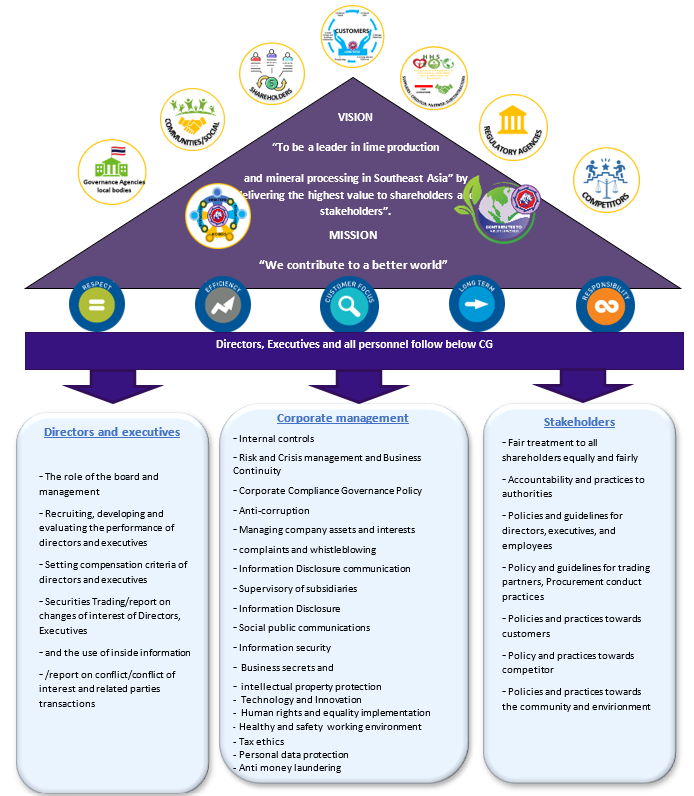
This policy applies to all persons working on our behalf in any capacity, at all levels and grades, including directors, officers, senior managers, employees (whether permanent, fixed term, or temporary), contractors, third-party representatives, and business partners in conducting business, and operations in an ethical, moral and honest manner for sustainable growth. The policy was distributed through organizational communication channels and published through its website. Additionally, annual training and new hires orientation have been organized by the HR department, and its booklets are also provided at accessible points. The latest revision is a fifth approved by the Board on February 21, 2025.
During the past year, the directors conducted a policy review and assessed its performance using its complaints received via provided channels, stakeholders surveys, and HR dept. The 2025 result is shown below.
No. | Complaints | Report/ issue |
1 | Use of insider information | No Violation |
2 | Report on securities holding in Company via Form 59 | No Violation |
3 | No Gift Policy | No claim |
4 | Trade secrets | No claim |
5 | Business ethics | No claim |
6 | Disciplinary dismissal based on HR Dept. report | An employee violated company regulations in a significant manner, leading to termination. |
Reported via complaint channels, stakeholders’ surveys, and HR dept | No violations and no complaints | |
The HR department conducts a briefing on the code of business ethics and Employee handbook as a preventive action against reoccurrence, compliance training programs address the Code of Conduct, anti-corruption measures, and conflict of interest awareness. Every employee-across all job levels and within subsidiaries-participates in these programs, resulting in complete (100%) engagement. | ||
The Company participating in the third-party assessment that reflects the Company’s ongoing commitment to excellent corporate governance and demonstrates its commitment to operating the company sustainably in accordance with Economic, Social, and Environmental Governance (ESG) principles and to build confidence among all stakeholders with sustainable business growth has received a corporate governance report 2025 (Corporate Governance Report of Thai Listed Companies 2024: CGR) 5 stars or “Excellent” (Excellent CG Scoring) for the sixth consecutive year from the Thai Institute of Directors Association ( IOD) with support from the Stock Exchange of Thailand.
Code of Conduct Link
https://goldenlime.co.th/en/corporate_governance/
Page Number in Report
44-120
Code of Conduct Practices
| Guideline | Detail | Document Link | Page Number in Report |
|---|---|---|---|
| Prevention of Misuse of Inside Information | Principle The Board of Directors has resolved to establish policies and procedures in conducting related party transactions to ensure that all actions are legal and ethical and do not compromise shareholder value. Guidelines 1) Director, executives and employees should avoid any action that against the interests of the company, either in the from contacts with your company's trade partners, such as partners, customers, competitors, or from using opportunities or information gained from being a director, or employees in their own interests, and doing business that competes with the company, or doing other work than the work of the company This has a detrimental effect on function on duty. 2) Directors, executives, and employees shall refrain from holding shares in the Company's competitors. In the case where an employee has acquired shares prior to employment, or before the company goes into business, or acquired by way of inheritance employees must report to the Company via hierarchical bosses. 3) No Director shall ,either for his/her own benefit or the benefit of others, operate any business which has the same nature as and is in competition with the business of the Company or become a partner in an ordinary partnership or become a partner with unlimited liability in any limited partnership or become a director of any limited company or public limited companies which has the same nature and is in competition with the business of the Company, unless he or she has notified to the shareholders meeting prior to the resolution for his or her appointment. 4) The Directors, Management and Employees shall not, for their own personal gains, receive any money or benefit from customers, or other benefits from other persons with duties or business related to the Company unless on traditional occasions or festivals’ standard practices. 5) The company has no policy in providing financial assistance, guarantees to individuals, executives, or companies that are not subsidiaries. 6) Personnel under employment contract should not spend office hours in doing any work for personal benefit resulting in neglect of duties and insufficient work time to carry out duties according to the scope of duties completely. | https://goldenlime.co.th/en/corporate_governance/ | 78-79 |
| Anti-corruption | Principle The Board has designated personnel at all levels to implement anti-corruption measures and encourage current and future Business Partners, alliances and subsidiaries to be involved in anti-corruption practices. The Company participates the Office of the National Anti-Corruption Commission as a pilot company of the morality and transparency of operations projet of private-sector agencies and no complaints are found regarding corruption from stakeholders. The Company policy aims to comply with the laws and set guidelines to ensure compliance with anti-corruption policies continuously. The Company is committed to support and supervise its executive, employees, agents, partners, and contractors to be aware of potential corruption and anti-corruption policies by showing its leadership in being anti-corruption. As the Company is a member of Partnership against Corruption for Thailand (PACT Network), it thus acts within the scope of definitions given by the Company as follows: Fraud and corruption include any act for unlawful advantage and any practice or omission of duty and/or abuse of power, violations of law, ethics, regulations or policy of the Company in order to secure any form of unlawful advantage such as soliciting, receiving, offering, or giving cash or any property including cash, goods or other favors, as well as any other benefits, to government officials or individuals who engaged in doing business with the Company for the benefit of the Company, and include: Political contributions refer to financial aid or otherwise in order to support political activities such as money lending, personnel support, providing goods or services, advertising to promote or support the political parties, buying tickets for raising funds or donating money to an organization with close ties to political parties, and so on. The anti-corruption model with; Guidelines 1. The Company encourages employees in all levels to realize and be conscious of the anti-fraud and corruption campaign. It also provides an internal control in a bid to prevent corruption and bribery extant in every country in which the Company makes an investment. 2. The Company shall create conscience, instill morality and stimulate a positive attitude among the employees requiring them to honestly adhere to the law and regulations. 3. The Company shall create an efficient and effective internal control system with audits and appropriate use of power to prevent employees from any involvement in corruption. 4. The Company’s directors, executives and employees shall refrain from any behavior relating to the demand or acceptance of assets or any other benefit or from condoning corruption for themselves or families, friends and acquaintance or others which may influence toward misconduct, cause dereliction of duties or cause harm to the Company. 5. The Company’s directors, executives and employees shall refrain from offering assets or any other benefits to external parties with the intent to influence such parties to engage in misconduct or abandon their duties or to pay a bribe for the benefit of the business. 6. The Company shall report its financial statements accurately and transparently. 7. The Company shall provide communication channels for employees and related parties for whistle-blowing, on the condition that whistle-blowers will be given complete protection. The Company shall also appoint officers to investigate such claims. 8. In order to clarify how the operation is of high corruption risk; the Company stipulates the administrators and all staff members to strictly adhere to the guidelines as follow; 8.1) Political contributions refer to financial aid or otherwise in order to support political activities such as money lending, personnel support, providing goods or services, advertising to promote or support the political parties, buying tickets for raising funds or donating money to an organization with close ties to political parties. However, it does not include the employees who join the activities on their own right; nevertheless, they cannot present themselves as Company representatives or use any Company assets, devices or instruments for political purposes. The Company insists on political neutrality. The Company will never provide a political party, politicians or a party’s candidates with financial assistance for the benefits of the Company.
8.2) Charitable contributions, donations and aid grants may result in risk to the Company as such an activity is concerned with payment without obvious profit, used as an excuse to prevent a charitable contribution with concealed purposes. The Company stipulates policy and regulation as follows: The Company is determined to provide donations for foundations, including associations, public charity, nursing homes, schools, Red Cross society and temples all of which are registered with the government Revenue Department, and these donations can be used as a tax deduction. It also scrutinizes provided donations for annual activities organized by either the Company or the temples under the allocated amount in the budget. In the case of an emergency caused by a public hazard or natural disaster, a donation can be made after obtaining approval from the administrators. However, in order to closely monitor and scrutinize the donation, extensive details and photographs must be attached together with the donation proposal.
8.3) Sponsorships are a way to publicize the Company’s business reputation which is different from donations for charity. This may be done for the purpose of business, brand or reputation of the Company which is risk because it is a payment for services or benefits that are difficult to measure and track. Sponsorships may be linked to bribery. The Company has established policies and guidelines regarding to the sponsorships, process to review and control, details as follows: (1) The sponsorships must be examined or proved that activities are truly carried out for social benefit or as an act of corporate social responsibility. In this case, various necessary documents including receipts, project details and logo photo must also be attached. (2) The sponsorships can be calculated, such as a contribution of accommodations and food, which is not related to the benefits for individuals or any agencies except as a decoration of honor traditionally practiced. (3) The sponsorships can be made only if the payee is specifically identified together with the request document so as to obtain approval from the Company’s administration.
8.4) Funding expenses provided to welcome customers and other hospitality expenses. The Company realizes how good relations with its business allies can lead to continual achievement. It therefore allows staff members to either give or receive gifts, hospitality or other benefits within conditions specified by the Company as follows: (1) The activities are carried out in line with the sales promotion policy, the trade conditions or the counselling service. It also includes the expenses of travelling, accommodations, food or gifts provided by customers or any expenses provided to welcome the customers, the investors or the shareholders who visit and observe the Company’s business management. This includes the gifts occasionally provided on annual festivals. (2) The expense funding is in accordance with related law. (3) The expense funding is for the benefit of the Company and for not the personal benefit of the employees. (4) The expense funding is not a kind of cash gift or equivalent to cash such as gifts or present readily exchangeable for cash. (5) Gifts or hospitality are offered in line with appropriate tradition or festivals. (6) Gifts or hospitality must not be offered especially during a bidding or procurement. (7) They are openly offered and not contrary to procurement ethics. 9. Anti-corruption policy covers the personnel management process including personnel selection, the promotion, the training, the working evaluation and bonus. For this reason, the superiors in all levels are required to create a right understanding among the employees and urge them to strictly adhere to this policy. They also have to closely monitor implementation of the policy to ensure operations are carried out efficiently. 10. The Company will provide justice and protection for any employee, or others, who provide notification regarding the whereabouts of or evidence related to corruption in the Company and its group company, including any employees who object to said corruption. They will be given protection under the protection measures as regulated in the whistleblower policy. 11. Those who are involved in fraud and corruption which are considered as offenses within the regulations of personnel management are to face disciplinary punishment or legal punishment if the acts prove to be legal offenses. 12. The Company will regularly examine the guidelines and operational measures in order to comply with any legal changes and the business conditions. 13. In order to closely monitor the operations in line with the anti-corruption policy, the Company administration are required to afford an annual self-assessment. 14. The Company requires all staff members, including the Board of Directors, the executives and employees to strictly adhere to anti-fraud and corruption measures and also urges its business partners to jointly carry out these measures. The co-company or sub-company, if likely to be set up in the future, is also to adhere to this policy. Responsibilities and Control o The Board of Directors is required to comply with anti-corruption policy, and put the policy into practice. o The Board of Directors has authorized the Managing Director to set up sub-committees. At present, the Managing Director has established sub-committees including a Safety and Health management committee, Energy preservation management committee, Quality management committee, and Management Committee. These committee members are authorized to jointly deliberate different fields of work and assign administrators in each agency to monitor and supervise operations in order to ensure good corporate governance policy. o The Audit Committee consists of independent directors who are responsible for reviewing internal control system and giving their opinion about internal control system, as well as ensuring that the Company complies with related laws. o The Audit Committee is in charge of assigning an internal auditor to review the internal control system. If the internal auditor is an external agent, the Audit Committee shall appoint a person who can coordinate with the internal auditor or assign the Committee’s secretary to act as the coordinator. o The Audit Committee is in charge of assigning an internal auditor to review the internal control system. If the internal auditor is an external agent, the Audit Committee shall appoint a person who can coordinate with the internal auditor or assign the Committee’s secretary to act as the coordinator. o The Internal Audit Coordinator shall be responsible for receiving any complaints or any claims and coordinate with the internal auditor to review and report to the supervisor or Manager or Audit committee about complains. Procedure of the Assessment of Corruption Risk The Company has regulated the risk management system based on business operation in a bid to prevent and suppress corruption or any activities of high risk from corruption likely to occur as a result of the Company’s business operation. It also evaluates the risk level including occurrence and impact as well as regulates the anti-corruption measures based on evaluated risk including the achievement evaluation and resources to be used to lessen the risk and follow up on the performance appraisal. Guidelines to Monitor Supervise and Prevent Any Involvement in Corruption Risk The Company has regulated guidelines to monitor, supervise and monitor the risk on fraud and corruption as follows: 1. Procedures, including an internal control system and risk management, which cover important work systems such as the sales and marketing system, procurement, control, budget management, account record and payment. This aims to prevent as well as monitor the risk on fraud and corruption and provide appropriate suggestions for solutions. 2. Provide a channel of receiving information, evidence, complaint of a legal offense or a violation of the Company’s business ethics, as well as guidelines to prevent any involvement in corruption, suspicions on the financial report or the internal control system. The Company is to provide protection for those who submit information or evidence. The information is to be treated as confidential. The Company must exercise disciplinary or legal punishment. Protection will be granted to those who submit evidence or complaint by means of written statement. Heads of each department are in charge of monitoring the operations and informing the persons in authority. | https://goldenlime.co.th/en/corporate_governance/ | 82-85 |
| Whistleblowing and Protection of Whistleblowers | Principles The Company has put in place complaint-making and whistle-blowing channels, covering complaint-filing, verification, and summary of findings, together with protection of the complainants and related parties for recording, tracking, correcting, and reporting to encourage employees to comply with the law Regulations and ethics in business operations. Guidelines 1) To establish the guidelines and procedures for the proper use of the Whistleblower Channel, Define complaint category, receive complaints, and collect facts relating to corruption, violation, or non-compliance 2) A complaint management, time period, and designation of responsible persons. 3) Measures to protect whistleblowers who report information or provide information with honest intentions. 4) An employee can file a workplace complaint and grievances following the policy. 5) Disclosure of reports and corrections can be found in good corporate governance performance on the Company's website and annual report. To supervise a mechanism for receiving complaints and taking action in the below topics through the complaint channel on the website where people find suspicions or offensive can notify the company through the channels provided Whistle-blowing or Complaint-making matters - Found fraud and/or concerns within the Company - Meet operations / activities that are not transparent to Shareholders - Personal data privacy - Code of conduct - Human Right - Discrimination - Sexual harassment - Non – sexual harassment - money laundering - violations to the laws - misconduct of employees - Detecting anomalies in financial statements, insufficient internal control system, various potential risks - Reputational damage and loss of credibility - financial damage and damages to infrastructure and assets - Others Any of the complaints mentioned above done by personnel can be reported by employees and stakeholders including inaccurate financial reports I, flaws of internal control in order to involve personnel as well as stakeholders in monitoring efficiently. Filing a complaint Filing a complaint should back up with as much provable fact or information as to be considered as complete complaint filing for further investigation process taken by the Company. The complete and acceptable complaint shall be composed of; Basic facts mean facts of the situation that may, in fact, be extremely important in getting complaint correctly investigated and resolved. Basic facts should be as accurate as possible in order to establish complaint credibility so basic facts should include: • Time and date • Place • The individual(s) or group(s) involved which may comprise not only those who are responsible for actions, policies of the Company, etc., but also subcontractors or operators involved in the complaint, potential witnesses, and others who may be needed to supply testimony or information. • Relevant addresses, phone numbers, e-mail addresses, websites, etc. • The number of incidents, and/or the duration of the problem, if it's ongoing. Besides, during investigation process, in case a complaint lacks essential information, the Company will seek and request for any of the following forms of additional details. • Photographs • Testimony of whistleblowers or other eyewitnesses • Testimony of people affected by the subject of the complaint • Legally obtained memos, letters, e-mails, or other documents confirming the substance and details of complaint • Logs, or audio- or video records of conversations • The testimony of experts - psychologists, environmental scientists, economists, public officials, etc. Others channel by SUTHA complainants are • victims of human rights violations /their representatives • A witness is a person who, being present when a human rights violation occurred. through the company's complaints channel • Telephone • Facsimile or email • the Company website Complainants contact info: Name and reachable address Telephone numbers / Email address GOLDEN LIME PUBLIC COMPANY LIMITED Internal Auditor/Internal Auditor Coordinator 7 Soi 11, Sai 3, Moo 12, New Saraburi-Lom Sak - Chong Sarika Subdistrict Phatthana Nikhom District Lopburi 15220 Phone: 036-436 178 - Email: complaint@goldenlime.co.th The secretary to the audit committee 89, Cosmo Office Park, 6th Floor, Unit H, Popular Road,Banmai Sub-district, Pakkret District, Nonthaburi Province 11120 Tel. 0 2017 7461-3 Fax.0 2017 7460 E-mail : complaint@goldenlime.co.th Responsibility and follow-ups • Board of Directors is responsible for formulating a policy and supervising anti-corruption process to ensure that the management recognizes and places importance on corporate governance in order to ensure transparency for shareholders and co-investors as well as relevant stakeholders. • The Board of Directors, executives and personnel including all stakeholders are required to comply with anti-corruption policies, and put these policies into practice. • The Board of Directors has authorized the Managing Director to set up sub-committees. At present, the Managing Director has established sub-committees including a Safety and Health management committee 5S,the sustainability development committee, the environment management committee ,the energy preservation management committee, Quality management committee, and Management Committee and working groups to manage various projects by assigning duties to help each other consider various aspects of work to ensure that operations and practices are in line with the good corporate governance policy. • The Audit Committee consists of independent directors who are responsible for reviewing internal control system and giving their opinion about internal control system, as well as ensuring that the Company complies with related laws. • The Audit Committee is in charge of assigning an internal auditor to review the internal control system. If the internal auditor is an external agent, the Audit Committee shall appoint a person who can coordinate with the internal auditor or assign the Committee’s secretary to act as the coordinator. • The Audit Committee is in charge of assigning an internal auditor to review the internal control system. If the internal auditor is an external agent, the Audit Committee shall appoint a person who can coordinate with the internal auditor or assign the Committee’s secretary to act as the coordinator. • The Internal Audit Coordinator shall be responsible for receiving any complaints or any claims and coordinate with the internal auditor to review and report to the supervisor or Manager or Audit committee about complains. • Receipt of Complaints and Whistleblower • Independent website provider receives complaints through the complaints channel on the website by forwarding to complaint@goldenlime.co.th • Supervisor / Supervisor in each department that employees trust • Company Secretary or Secretary to the Audit Committee • Coordinator with internal auditors or financial control manager • Human Resources Department • Public relations officer The follow-up process starts with receiving issues from the responsible unit to notify the chief or supervisors. Then in case the issue is considered a high-risk or high-severity issue, it must be reported in order from the department level, to the Managing Director to the meeting of the executive committee or any relevant committees depending on the impact and severity of the issue. If the issue is considered high or very high risk causing a big impact on outsiders, its impact and damage should be brought into the mitigation plan for implementing correction, mitigation, and remedies, compensation to provide relief to those affected or to have corrective action to get back to normal state or the risk level is reduced to an acceptable level. In the case of a complaint related to fraud or violating the code of conduct, there will be a process to investigate and verify the issue, If true, an employee shall be subject to penalties and reported. If the Company can contact those who address a complaint, the Company should report the complaint treatment status within 30 days. If the complaint closure requires longer days than previously identified, the Company shall report continuously until its closure. Protective Measures for Whistleblowers and Investigative Participants. To provide appropriate protection measures for whistleblowers, the following guidelines have been established. 1) The complainant can choose to remain anonymous for safety reasons. On the contrary, the Company can report progress and clarify the facts. 2) A Complaint Recipient shall - Set up a database for the confidential information of whistle-blowers and establish punitive measures against the officers in charge of keeping such a database if the confidential information is leaked. - This database must be made accessible to executives at the level of senior executive management only. - The Committee is determined to provide protection for the administrators or employees who report corruption or who adhere to anti-fraud and anti-corruption policy, which may otherwise result in the loss of business opportunity. It also seeks prevention for the employees from any penalty or position downgrade as a result of strictly adhering to the guidelines. - It falls under the authority of the superiors or supervisors of all those accused to give proper directives to protect whistle-blowers, witnesses, and those who provide evidence to the investigation to keep them out of danger, difficulties, or unfairness due to their making complaints, serving as witnesses, or giving information. Questions or Recommendations Any question or recommendation on corporate governance and anti-corruption policies should be addressed to the Secretary to the Audit Committee and Secretary to the Board of Directors, Telephone Number 0 2 017 7461-3 or Email: thidarat.sihawanlop@goldenlime.co.th Punitive Measures 1) Those found guilty of serious misconduct will be dismissed from the Company and face legal punishment if they are found to be guilty of legal misconduct. Those found guilty of minor offences will face score reduction or a suspension from duties without any wages. They will also face a score reduction for job evaluation as well as the restriction from promotion and the restructure of income rate. 2) The superiors are to reprimand those found in violation of the Company’s ethics including by score reduction for job evaluation, restriction from promotion or the restructure of income rate. 3) Those found in violation of the Company’s regulation will receive a written reprimand from the Human Resources Department including score reduction for job evaluation, restriction from promotion or the restructure of income rate. 4) In case the offenders are the high-ranking administrators or on a Company committee, findings of the investigation must be forwarded to the Board of Directors in order to determine the penalty. The penalty will be based on legal considerations and good corporate governance. | https://goldenlime.co.th/en/corporate_governance/ | 85-90 |
| Preventing the Misuse of Inside Information | Prevention of Use of Inside Information Principle The Board of Directors has established written guidelines for the preservation and prevention of the use of internal information by prohibiting all directors, executives and employees from using the Company's internal information for their own benefit therefore. Establish guidelines to prevent the use of inside information and the penalties as follows; Guidelines 1) The directors, executives and employees are forbidden from exploitation of inside information that has a significant impact on the Company’s securities trading and the change in share price that has not yet been declared to the public for their personal or other’s interest. 2) Ensuring the directors and executive officers of the Company including their spouse and minor children report the holding of securities and report the changes in the Company's securities holdings to SEC pursuant to Section 59 and penalty provisions under section 275 of the Securities and Exchange Act B.E.2535 (include the amendment) and send copies of this report to the Company the same day that the reports are submitted to SEC.the Securities transactions of directors and executives, Report on changes in securities trading and prevention of use of inside information. 3) The directors, executives as well as those in the executive positions of accounting or finance unit from the level of manager and above and employees in the unit where inside information is available must refrain from the Company’s stock trading for one month prior to the date of announcement of operation results and financial statement or important information that have impact on the change in the Company’s stock price until such information is declared to the public. 4) The directors, executives as well as those in the executive positions of accounting or finance unit from the level of manager and above shall report ownership of all securities issued by the Company, pertaining to themselves, spouses and/or minor children to the Company Secretary within 30 days after formally assuming the position. Besides, the directors and high-ranking executives shall report to the Board of Directors or the delegated person all of their securities trading at least 1 day in advance in order to notify SEC within three business day after transaction date as specified by the Securities and Exchange Act. More guidelines in the changes in securities and derivatives holding report 5) The Company secretary is to inform all the closed periods in the yearly meeting plan of the Board meeting announced in advance for directors, executives as well as those in the executive positions of accounting or finance unit from the level of manager and above and relevant employees to refrain from the Company’s stock trading for one month prior to the date of announcement of operation results and financial statement Directors, executives, employees who violate the inside information policy will be subject to disciplinary action and/or the law up to the intent of the act and the seriousness of the offense. | https://goldenlime.co.th/en/corporate_governance/ | 76-77 |
| Prevention of money laundering | Principle Golden Lime Public Company Limited has formulated guidelines for compliance with anti-money laundering Act B.E. 2542 (1999) in consistent with the Anti-Money Laundering (AMLO) guidance, the Company has established a policy to suppress money laundering and financing terrorism. Guidelines 1. Set practices for prevention and suppression of money laundering and the financing of terrorism and the proliferation of weapons of mass destruction. 2. Set management guideline for money laundering from trading with customers and trading partners 3. Perform customer risk management and verify customers' identities prior to establishing business relations with customers. | https://goldenlime.co.th/en/corporate_governance/ | 110 |
| Giving or receiving gifts, entertainment, or business entertainment | Principle The Company adopts an anti-corruption policy to ensure efficiency in management and comply with the standard of SET-listed entities, and gives priority to the fight against corruption in all forms. It also promotes and raises, among its personnel at all levels, the anti-corruption awareness and the adverse effects of corruption, instills the moral values in them, and enhances confidence among all groups of its stakeholders including trading partners as prescribed in procurement code of conducts. Guidelines Acceptance of gifts, tokens, entertainment, and preferential treatment 1. Acceptance of gifts or tokens The Company requires that all employees do not accept gifts or tokens that may be perceived as bribes. However, accepting gifts or tokens of low value on traditional occasions, including calendars, diaries, or stationery items normally considered nominal tokens, is not an issue. 2. Acceptance of entertainment Acceptance of entertainment can be considered based on suitability. Nevertheless, the Company advises that it should be avoided unless absolutely necessary. In addition, it is against the Company’s ethics to ask trading partners for treatment at parties or other entertainment functions. 3. Preferential treatment In case of a bidding being open to trading partners, the process must be carried out without any preferential or intimate treatment to any particular suppliers or venders that could be perceived as in equal, leading to misunderstanding with other bidders who may pull out from the bidding. In addition, the image of improper behavior can harm the Company’s reputation. | https://goldenlime.co.th/en/corporate_governance/ | 117-118 |
| Compliance with laws, rules and regulations | Corporate Compliance Governance Policy Principles To ensure that the operations of the company and its subsidiaries comply with relevant regulations, directors, executives, and all employees must perform their duties with responsibility, diligence, honesty, and in accordance with business ethics and stakeholder practices. The company has established this Corporate Compliance Governance Policy, which is the direct responsibility of all directors, executives, employees, and any other individuals working on behalf of the company and its subsidiaries. Definitions • Regulations: Requirements that the company must follow, including laws, rules, company regulations, contractual obligations, shareholder meeting resolutions, business ethics, policies, operational standards, best practices, and social commitments. • Compliance: Adherence to laws, rules, company regulations, contractual obligations, business ethics, policies, operational standards, best practices, and social commitments relevant to business operations. • Governance: Processes used to prevent non-compliance with relevant regulations and mitigate impacts from non-compliance through various measures such as collecting relevant regulations, assessing and ensuring compliance, monitoring, auditing, correcting, risk management, training, communication, awareness-building, and resource allocation. • Executives: Employees responsible for managerial positions, including senior managers, managers, department heads, and supervisors, who are involved in policymaking or overseeing compliance with company policies. • SUTHA: Golden Lime Public Company Limited and its subsidiaries as per the consolidated financial statements. Corporate Compliance Governance Policy 1. Directors, executives, and all employees must adhere to regulations, including laws, rules, company regulations, shareholder meeting resolutions, contractual obligations, business ethics, policies, operational standards, and best practices. 2. Comply with laws and regulations, especially domestic and international laws related to business operations, such as labor, human rights, anti-corruption, anti-bribery, conflict of interest prevention, anti-money laundering, fair competition, intellectual property protection, and other relevant business laws. 3. Compliance with laws and regulations is an integral part of the duties of directors, executives, and employees, who must communicate, promote, and support understanding, establish guidelines, and oversee proper compliance, fostering a culture of honesty and integrity. 4. Employees responsible for recording, reporting, or providing information about actions that violate laws, regulations, or neglect duties that result in significant damage or legal disputes will be protected under the Whistleblowing Policy. Corporate Compliance Governance Practices 1. Define the scope of issues and stakeholders involved in implementing the compliance governance system. Executives determine the scope of laws and regulations to be included in the system and assign responsibilities within the relevant scope. 2. Establish standards and internal control systems to ensure that operations within the scope of responsibility do not result in legal or regulatory violations. 3. Oversee and enhance the effectiveness of daily operations by ensuring that work aligns with established standards, monitoring and auditing, reporting on compliance, addressing any instances of non-compliance, managing compliance risks, and routinely assessing compliance processes. 4. Support operations by ensuring compliance with regulations through adequate resource allocation, enhancing employee knowledge and skills, fostering a culture of awareness and adherence to compliance, and managing the necessary documents and information for effective operations. Roles and Responsibilities 1. The Board of Directors sets the Corporate Compliance Governance Policy and practices, overseeing at the policy level and assigning the Corporate Governance Committee to monitor and review the policy, and the Risk Management Committee to ensure compliance with the policy. 2. Directors and the Managing Director support the creation of good awareness, promote compliance, and encourage employees to value and understand the importance of compliance, setting a good example. 3. The Audit Committee reviews control and monitoring processes for compliance governance, including internal control systems and compliance summaries. 4. Executives are primarily responsible for implementing the policy concretely and continuously, understanding the compliance governance policy, practices, and relevant regulations, communicating, promoting compliance, and ensuring employees under their responsibility comply correctly. | https://goldenlime.co.th/en/corporate_governance/ | 81-82 |
| Use and maintenance of data and assets | Responsibilities for the Company's Assets Principles A company asset is any intangible or tangible item that produces positive value for the company. Tangible assets have a physical presence, such as machinery and real estate, are subject to depreciation and have a life cycle of more than a year. Intangible assets are harder to evaluate, measure, and define because they have no physical presence. For example, brand identity and intellectual property are intangible assets. Employees and related parties jointly take responsibility, control, and maintain assets and do not take the company's assets to use for the benefit of oneself and others unless permitted by the approval authority or in accordance with regulations, welfare rules and job duty. Guidelines 1) Executives and staff should use the Company's assets with caution and responsibility for business purposes and do not use company assets for the benefit of yourself or others without permission. 2) Executives and staffs have to help maintain and careful not to make any property damage or loss of the Company's depreciation. 3) Operational output is considered an asset of the company and should not be used for personal gain. 4) Directors, Executives and staffs shall not engage in any act that results in a conflict of interest, either arising from the communication with the Company’s business related parties, for example, suppliers, customer and business competitors or from using information gained from the position as a director or employee, for personal interest. 5) Directors, Executives and staffs shall not conduct any business which is competitive with the Company’s business nor engage in other employment that may inappropriately impact their assigned duties. 6) If company property is damaged or lost, employees or responsible persons have to be responsible as specified in regulations or policies of the company 7) Every Department should control the use of the Company Assets to maximize the benefits to the Company with environmental and energy awareness. 8) Executives and staffs may not use company assets when not associated with the Company 9) Protect the assets of the company and prevent risks that may affect the property. | https://goldenlime.co.th/en/corporate_governance/ | 85 |
| Anti-competitive | Antitrust/Anticompetitive Practices Principle The Company established guidelines to regulate business operation and prescribed practices in the interest of ensuring free and fair trade competition; Guidelines 1. The Company operates in compliance with its business ethics, the trade competition act prohibiting all employees from unfair trade practices, interfering with the market mechanism, or free competition resulting in destroying, damaging, obstructing, or restricting the business of others. 2. In the case that the Company dominates the market or legally gains market power as a result of acquiring control of competitors, the Company including its employee shall not exercise an unfair or unreasonable authority that may result in failing the market mechanism. 3. The Company will not take any action to eliminate the competition either directly or indirectly by exchanging trade data, or entering into an agreement with a competitor, partner, or customer to prevent, distort, or restrict competition. 4. Parties involved in the business both domestically and internationally shall be aware and comply with the laws, rules, policy and practices on trade competition of the countries where they do business. This includes mergers and acquisitions. 5. Employees shall always be aware that compliance with trade competition laws is extremely important in running a business to ensure that the Company's business operations in respect with trade competition laws as well as providing knowledge to partners. Responsible parties for transactions and investments must set up a control system to ensure that they comply with trade competition laws correctly and completely. | https://goldenlime.co.th/en/corporate_governance/ | 119 |
| Cyber security | Principle The Company realizes the efficient and right information technology usage without infringement of copyright or intellectual property Including protection measures taken from unauthorized access and application. Guidelines 1) The Company has established an information technology security policy to notify users duties, responsibilities and guidelines to control in order to prevent information security risks by providing the Company's efficient operational control and information technology security guidelines under the same standard which is published through the website of the company. 2) The Company and its responsible personnel supervise to ensure that the readiness of information technology. 3) The use of the Company’s information technology systems shall be beneficial to the Company. Employees shall not use the information system of the Company to infringe other rights or affect the performance of the system. The Company does not allow the use of any pirated software, hardware, tools/devices that are irrelevant to the work or threaten the system. 4) Employees shall use the system under their own authorization limit not giving others the password for accessing to the system. 5) Employees should avoid websites that are illegal, against tradition or good morals. 6) Employees shall notify the IT department not install programs by themselves, edit, change settings that may affect the organizational system. 7) Employees must adhere to the policy and non-infringement of intellectual property or copyright that the company strictly defined. | https://goldenlime.co.th/en/corporate_governance/ | 96 |
| Environmental management | Principles Adhere to ISO 14001 to ensure efficient environmental operations to reduce risks and expenses that may result from violations or consequences of non-compliance with environmental requirements. Guidelines 1. Environmental management in accordance with ISO 14001 “ The Environment policy ” is as follows: Golden Lime Public Company Limited is committed to responsibly manufacturing and distributing calcium oxide, calcium hydroxide and calcium carbonate with quality according to customer needs with environmental awareness by continuous environmental improvement and development in accordance with the laws, Environmental customer requirements and other requirements as per following guidelines 1. Promote energy and natural resources optimization, prioritize resource efficiency 2. Pollution-control strategies, in general, seek to manage a pollutant and reduce its impact upon the environment 3. Set objectives, goals and continuously improve environmental operations. 4. Adherence to environmental laws, regulations, guidelines, and specifications relevant to business processes. 5. Providing information and training to all employees and persons working for, or on our behalf to encourage effective contribution to our environmental goals. 2. Designated persons to manage environmental issues 3. Targets, indicators, and controls are in place 4. Disclose quantitative outcome obtained from environmental treatment and products | https://goldenlime.co.th/en/corporate_governance/ | 127 |
| Human rights | Human rights and non discrimination Principle The Company has established policies and business ethics by laying out guidelines for compliance with the respect for human rights by treating everyone equally regardless of national origin, race, sex, age, skin color, religion, disability or any status unrelated to work, including providing fair employment conditions and opportunity for equitable advancement. The supervision and practices are implemented to prevent harassment or intimidation or infringe upon personal liberties between executives, employees or those related to the Company to increase the recognition and respect to individuals’ privacy rights and operate following the Personal Data Privacy Policy. The Company, therefore, sets out the framework for human rights implementation as follows: Respect for privacy the right of every person to see the respect of his private and intimate life, not harm others’ privacy either unintentionally or intentionally equal treatment, non-discrimination on the grounds of age and sex, and proportionality. Non-threatening not making someone feel afraid or worried SUTHA practices to implement Human Rights principles SUTHA values the importance of human rights principles by placing importance and value on human rights and dignity to human capital which is the fundamental factor that will lead the organization to success. The Company’s human rights practices are as follows; Guidelines 1) Freedom of association or collective bargaining Allowing employees, the freedom of association and collective bargaining not contrary to laws, royal decree, statutes, or organizational rules to negotiate fairly under general rules or rules of the organization as well as appropriately to the conditions of business. 2) Forced labor Labor operations are carried out in compliance with applicable labor laws in each locality and there is no illegal forced labor. 3) Employment is in compliance with the law and only legally licensed migrant /foreign workers are eligibly employed with pre-employment verification to simply confirm the employment information provided by the candidate. All assigned works to all groups of employees are voluntary consent which are free from coercion and all practices towards employees are in accordance with the relevant laws. 4) Minimum age of employment No child labor in accordance with local labor laws 5) Equality of treatment There shall be honesty, equity and fair treatment in the workplace to ensure all employees are treated with respect and dignity regardless of where they work. All employees are employed under applicable legal terms and conditions of employment or usual practices including receiving proper training as per the framework of guidelines as follows: - Fair and Equitable Treatment: The Company has established guidelines for compliance with the principles of equality within the establishment as follows: Recruitment and selection of employees: The Company offers equal job opportunity regardless of race, religion, skin color, gender, age, cultures or personal belief , gender-diverse people, vulnerable group such as female ,underprivileged people ,the elderly, minorities and foreign workers ,outsourced worker and local communities that may be involved in business activities. The Company also establishes the specific guideline in order to support the Government’s policy in hiring people with disabilities, however, if the Company cannot meet the government regulations, the Company willingly contributes to the State Fund for Rehabilitation of Disabled Persons Fund. The Company has no policy of exploitation by violating the human rights of child labor and no employment or contract for child labor. Instead, upon corporation with educational institutes, the Company provides career support through career development internships or on-the-job training programs that comply with regulations and laws on students' consent and voluntary basis to attend training. Students are welcome to participate in the training for academic curriculum assessment, which shall be proposed with a confirmation letter from by their schools. The students will be advised to work according to the training guidelines without enforcement and overtime. Interns do not have wages, just allowances or travel expenses, food welfare or other welfare according to the criteria of each training establishment The compensation for employees is based on fairness and appropriateness with their duties and responsibilities in consistent with wage management according to the ability of an individual employee and legal wage rates including the determination of fair and appropriate benefits and welfare. - Anti-Slavery and Human Trafficking All relevant business activities shall not involve slavery, human trafficking but insist on helping ending slavery and human trafficking including forced labor, child labor, and illegal labor. - Non-discrimination and no torture by treating stakeholders with respect and dignity, building and maintaining positive relationships, unity but prohibiting harassing, destructive behavior, torture, mental, physical, sexual or verbal abuse including threatening, or intimidating. - Respecting employee Privacy Rights Including complying with the law on the protection and protection of personal information of customers, business partners, employees and other relevant stakeholders. - Providing safety supervision for both personnel and workplace in order to operate and perform safely including having an appropriate working environment. 6) Working hours and holidays in compliance with all applicable laws including labor regulations for normal working hours, overtime hours, regular breaks, rest breaks, holidays, leave days, etc. 7) Wages and Benefits To pay wages and benefits to employees at least at the rates required by law or labour standards including carrying out any joint agreements between employers and employees on various matters which have been mutually agreed upon. To prevent any other form of action that imposes penalties with unlawful deductions of wages and do not discriminate against any form of employment and compensation that is unlawful. 8) Safety and health There is a systematic process, safety equipment and management to ensure safe workplace and safe operation to all employees, partners, stakeholders to prevent injury and illness from work. 9) Working environment Organizing the working environment to meet the standards required by law in a way to support a safe and positive working environment that does not affect the health of employees such as drinking water, sufficient lighting, proper temperature and proper ventilation. To promote good health and a healthy workplace, proper safety equipment is provided and maintained in accordance with the standards required by law. 10) Emergency preparedness to get prepared for emergency situations, such as alerts and evacuation procedure, emergency training, contingency practice, sufficient and practical first aid equipment, fire protection plan, firefighting equipment, adequate emergency exit, emergency response plan and procedure including medical treatment in case of emergency. 11) Product quality and safety All products and services delivered either from partners or the Company shall meet the quality and safety requirements. All products and services are to be delivered on time with sufficient product-related information to ensure safe use of the product and prevent any impact to the safety and the environment. By this, all partners must not violate any labor laws and human rights. 12) Social and Environmental Sustainability Conforming to environmental laws, regulations, and standards including other actions to prevent the operating process from negatively affecting society and the environment by careful management and focusing on operating with social and environmental responsibility. 13) Anti-corruption in cooperation with business partners, customers and all stakeholders to comply with the code of business conduct through recognizing that corruption is a major obstacle for the ongoing sustainable development. All group of stakeholders shall not either directly or indirectly offer or promise any personal benefit or improper benefit to maintain business operations or receive other benefits from outsiders whether government or private sectors, business partners; not pay or accept bribes or all types of corruption. | https://goldenlime.co.th/en/corporate_governance/ | 102-108 |
| Occupational health and safety | Health and safety at work Principles The Company implements ISO 45001 Occupational Health and Safety Management System to improve employee morale, reduce workplace accidents to zero , and demonstrate a commitment to safety, which collectively lead to increased productivity and business growth. Guidelines 1. Managing to ensure healthy and work safety in an appropriate environment. 2. Establish and review objectives, target of occupational health, safety and workplace environment 3. Maintain standardized Health and safety of employees. 4. Safety assessment to contractors/partners 5. Prevention and risk mitigation 6. Safety record and safety investigation Lost Time Injury Frequency Rate: LTIFR / Lost Time Incident Rate: LTIR, Absent Rate: AR 7. Training on safety awareness 8. Safe work practices Occupational Health and Safety are as follow; Golden Lime Public Company Limited is committed to responsibly manufacturing and distributing calcium oxide, calcium hydroxide and calcium carbonate with quality according to customer needs with safety awareness by continuous safety improvement and development in accordance with the laws, legal requirements, and other requirements as per following guidelines 1. Arrange safe working environment 2. Comply with legal and other requirements. 3. Eliminate hazards and reducing risks. 4. Continuous improvement of the occupational health and safety system. 5. Assist operators in safety matters | https://goldenlime.co.th/wp-content/uploads/2025/11/Corporate_Governance_Policy_2025_EN.pdf | 132 |
Promoting Compliance with the Code of Conduct
Promotes Compliance by Directors, Executives and Employees
Yes
Description
Promotion of compliance with the business code of conduct
The board of directors and executives shall lead (CG Leader) in implementing, advising communicating, promoting, and training in order to strengthen knowledge and understanding of good corporate governance and business ethics guidelines and be a good example for other trading partners as well as seriously follow up on compliance and employees treat stakeholders responsibly in order to drive and develop the business towards stability and sustainability.
The Human Resources Department is responsible for annual staff policy training along with orientation for new staff including publishing and communicating all policies with internal medium and keep record training for improvement. The QR code for good corporate governance is published via the Stock Exchange of Thailand site whereby interested stakeholders can learn good corporate governance to develop businesses towards sustainability. You can scan the QR code to open the link . Performance indicators are collected from complaints received via provided channel and various sustainability assessments from external parties.
Process Document Link
https://goldenlime.co.th/en/corporate_governance/
Page Number in Report
Page 16
Anti-Corruption Networks & Projects
Joined or Declared Intent to Join Anti-Corruption Networks
Yes
Networks & Projects Joined
| Network / Project | Network Name — Please Specify |
|---|---|
| Thai Private Sector Collective Action Against Corruption: CAC | |
| United Nations Global Compact (UNGC) | |
| Participation of anti-Corruption networks and initiatives | Nation Anti-Corruption Commission |
Material Changes & Developments in CG
Reviewed the CG Policy or Board Charter in the Past Year
Yes
Material Changes or Developments in the Past Year
Yes
Policy Review — Description
The company has implemented a written policy, which was last updated and presented to the Board of Directors meeting on February 21, 2025.
The policy was reviewed to update its annual content and to include additional guidelines to ensure compliance with applicable laws, rules, and regulations. This review aims to clearly communicate the Board-approved policy as a practical framework for executives, employees, and relevant stakeholders.
The latest version of the document is published on the company's website and stored in the organization's internal Share Drive. The latest document can be downloaded in electronic format from the company's website.
ESG sustainability development and business ethics | |||
Policy : ESG sustainability development and business ethics Version : TH/EN Format : E-book, published manuals with its latest revisions available
latest revisions available on the company website |
| ||
TH | selected download Corporate Governance policy | ||
EN | selected download Corporate Governance policy | ||
Implements the CG Code for Listed Companies
No
CG Code — Description
The company operates and manages in accordance with corporate governance principles, with consideration and review of business ethics practices to establish guidelines for stakeholder engagement. This ensures alignment with the operations of listed companies and adheres to the management structure, strategy, value creation, regulatory compliance, internal control, internal audit, risk management, and the management of relationships between the board of directors, management, employees, and shareholders. The board, executives, and employees collectively adhere to these practices, continuously improving processes to align with sustainable business operations and the principles of good corporate governance that have been adapted and applied. Corporate Governance Code for listed companies 2017 (Corporate Governance Code for listed companies 2017: CG Code 2017”)
In addition, corporate governance is conducted according to five fundamental principles:
1) Management with honesty and adherence to correctness.
2) Fair treatment of the organization's stakeholders.
3) Operations with transparent disclosure of information to relevant parties, ensuring accountability.
4) Performing roles and responsibilities with full intelligence and capability, striving for success and continuous improvement.
5) Accountability for actions resulting from orders, delegations, and decisions within one's role, with the ability to explain and justify those decisions.
In addition, policies for governance, rules, and operational guidelines have been established to provide a clear framework for practice as follows:
Corporate Compliance Governance Policy
Principles
To ensure that the operations of the company and its subsidiaries comply with relevant regulations, directors, executives, and all employees must perform their duties with responsibility, diligence, honesty, and in accordance with business ethics and stakeholder practices. The company has established this Corporate Compliance Governance Policy, which is the direct responsibility of all directors, executives, employees, and any other individuals working on behalf of the company and its subsidiaries.
Definitions
• Regulations: Requirements that the company must follow, including laws, rules, company regulations, contractual obligations, shareholder meeting resolutions, business ethics, policies, operational standards, best practices, and social commitments.
• Compliance: Adherence to laws, rules, company regulations, contractual obligations, business ethics, policies, operational standards, best practices, and social commitments relevant to business operations.
• Governance: Processes used to prevent non-compliance with relevant regulations and mitigate impacts from non-compliance through various measures such as collecting relevant regulations, assessing and ensuring compliance, monitoring, auditing, correcting, risk management, training, communication, awareness-building, and resource allocation.
• Executives: Employees responsible for managerial positions, including senior managers, managers, department heads, and supervisors, who are involved in policymaking or overseeing compliance with company policies.
• SUTHA: Golden Lime Public Company Limited and its subsidiaries as per the consolidated financial statements.
Corporate Compliance Governance Policy
1. Directors, executives, and all employees must adhere to regulations, including laws, rules, company regulations, shareholder meeting resolutions, contractual obligations, business ethics, policies, operational standards, and best practices.
2. Comply with laws and regulations, especially domestic and international laws related to business operations, such as labor, human rights, anti-corruption, anti-bribery, conflict of interest prevention, anti-money laundering, fair competition, intellectual property protection, and other relevant business laws.
3. Compliance with laws and regulations is an integral part of the duties of directors, executives, and employees, who must communicate, promote, and support understanding, establish guidelines, and oversee proper compliance, fostering a culture of honesty and integrity.
4. Employees responsible for recording, reporting, or providing information about actions that violate laws, regulations, or neglect duties that result in significant damage or legal disputes will be protected under the Whistleblowing Policy.
Corporate Compliance Governance Practices
1. Define the scope of issues and stakeholders involved in implementing the compliance governance system. Executives determine the scope of laws and regulations to be included in the system and assign responsibilities within the relevant scope.
2. Establish standards and internal control systems to ensure that operations within the scope of responsibility do not result in legal or regulatory violations.
3. Oversee and enhance the effectiveness of daily operations by ensuring that work aligns with established standards, monitoring and auditing, reporting on compliance, addressing any instances of non-compliance, managing compliance risks, and routinely assessing compliance processes.
4. Support operations by ensuring compliance with regulations through adequate resource allocation, enhancing employee knowledge and skills, fostering a culture of awareness and adherence to compliance, and managing the necessary documents and information for effective operations.
Roles and Responsibilities
1. The Board of Directors sets the Corporate Compliance Governance Policy and practices, overseeing at the policy level and assigning the Corporate Governance Committee to monitor and review the policy, and the Risk Management Committee to ensure compliance with the policy.
2. Directors and the Managing Director support the creation of good awareness, promote compliance, and encourage employees to value and understand the importance of compliance, setting a good example.
3. The Audit Committee reviews control and monitoring processes for compliance governance, including internal control systems and compliance summaries. Executives are primarily responsible for implementing the policy concretely and continuously, understanding the compliance governance policy, practices, and relevant regulations, communicating, promoting compliance, and ensuring employees under their responsibility comply correctly.
Adhering to good corporate governance principles and business ethics as a guideline for conducting business with transparency and accountability to stakeholders, SUTHA strives to be an organization that is free from corruption and all illegal misconduct through good corporate governance policy, business ethics including practices for directors and executives, policies and practices prepared in the form of publications, media for both internal and external stakeholders as per the following.
Other CG Performance & Outcomes
The evaluation from a corporate governance survey of listed companies (CGR SCORE)
CGR SCORE | 2023 | 2024 | 2025 | |
SUTHA CGR Average Score Y 2025 SUTHA'S score level is Excellent For 6 consecutive years | 113 (+bonus) Excellent
| 111 (+bonus) Excellent
| 106 (+bonus) Excellent
| |
Benchmark | Score | |||
Average of Thai Listed Companies | 84 | 81 | All Listed average score | 83 |
SET50Index | 93 | 103 | Industry Quartile 1 | 95-111 |
SET100Index | 92 | 99 | Market Cap 1500-3000 MB | 93-109 |



The evaluation of the Annual General Shareholders’ Meeting Quality Evaluation (AGM CHECKLIST)
AGM CHECKLIST Evaluation by THAI INVESTOR ASSOCIATION | |||
Yearly | 2023 | 2024 | 2025 |
SUTHA AGM Score | 95
| 100
| 96
|



ECOVADIS on Social and Environmental Performance
Evaluation results ESG_SET ESG RATING | 2023 | 2024 | 2025 |
Sequencing | 71/100 | 73/100 | 81 /100 |
Percentile | 94% | 93 % | 97 % |
Rating | “GOLD” | “SILVER” | “GOLD” |
Average Score of SUTHA | |||
| 80/100 | 80/100 | 80/100 |
| 70/100 | 70/100 | 82/100 |
| 70/100 | 80/100 | 82/100 |
| 50/100 | 50/100 | 82/100 |
SET ESG Rating
SET ESG RATING | 2023 | 2024 | 2025 |
Rating | “A” | “AA” | “AA” |
Publicly disclosed assessment results | |||
Average performance score | 73/100 | 82/100 | 83/100 |
Average Environment - SUTHA | 79/100 | 89/100 | 90/100 |
Average Social – SUTHA | 71/100 | 71/100 | 75/100 |
Average Governance – SUTHA | 69/100 | 88/100 | 84/100 |
FTSE Russell ESG Rating (Effective Public Disclosure: Year 2026)
SET ESG_RATING-FTSE Russell | 2024 | 2025 | ||||||
SUTHA | Sub-Sector Average | Industry Average | Country Average | SUTHA | Sub-Sector Average | Industry Average | SUTHA | |
Rating | 2.3 | 2.4 | 2.5 | 3.1 | 3.1 | 2.6 | 2.7 | 3.6 |
Average Score of SUTHA | ||||||||
Average Environment - SUTHA | 1.1 | 1.8 | 2.2 | 2.3 | 2.1 | 2.1 | 2.3 | 3.0 |
Average Social – SUTHA | 2.2 | 2.1 | 2.2 | 2.8 | 2.6 | 2.2 | 2.4 | 3.4 |
Average Governance – SUTHA | 4.0 | 3.6 | 3.5 | 4.2 | 5.0 | 4.0 | 4.1 | 4.5 |