

MD&A · 2025
In this section4 topics
Overview of Operations
Overview of Operations
Operation Overview With extensive experience as a producer and distributor of lime products including calcium oxide, calcium magnesium oxide, calcium hydroxide and powdered calcium carbonate, primarily serving large-scale industrial sectors, SUTHA remains committed to continuous product development and innovation. The company emphasizes a high level of supply reliability, efficient logistics services, customized packaging solutions, and technical support in product applications to enhance market opportunities and deliver maximum value and satisfaction to its industrial customer base. SUTHA is dedicated to sustainable growth, integrating Environmental, Social, and Governance (ESG) principles into its operations while maintaining a strong focus on business performance targets. Through relentless improvement and customer-centric strategies, the company aims to strengthen its position as a trusted partner across diverse industrial sectors and emerging markets. |
|
Economy, Industry Conditions and impact to our business
Thailand’s economy in 2025 expanded modestly within the projected 1.8-2.3% range, reflecting slower momentum amid structural challenges and external trade pressures. The outlook softened through the year as U.S. tariff measures and geopolitical uncertainties weighed on exports, investment sentiment, and manufacturing activity.
The Thai Baht experienced bouts of appreciation during 2025, influenced by capital flows and global monetary shifts, affecting cost competitiveness for exporters.
Thailand’s steel consumption continued to grow in 2025, with finished steel demand rising 10.7% in Jan-May 2025, driven primarily by construction activity and infrastructure investment
Exports, however, recorded strong headline growth, rising 12.9% to USD 339.6 billion, driven mainly by electronics and technology-related products, despite continued weakness in agricultural categories.
Inflation stayed subdued within 0.0-0.5%, supported by low energy and fresh food prices. The Bank of Thailand maintained an accommodative stance, cutting the policy rate multiple times to 1.50% to support liquidity amid weak domestic demand and high household debt.
DOMESTIC LIME MARKET segment performance:
This letter is part of Sutha’s Annual Report. As a public company, we publish mandated quarterly data, but we also feel responsible for sharing our perspectives on your investment and our business approach. We aim to communicate transparently, as we would expect if our roles were reversed, reporting both positive and negative developments at Sutha. Our goal is to provide you with all relevant facts, figures, trends, and insights needed to assess your investment fulfilling the true purpose of an Annual Report.
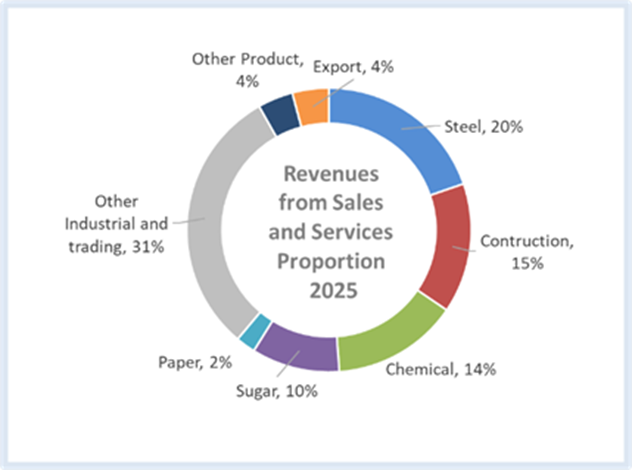
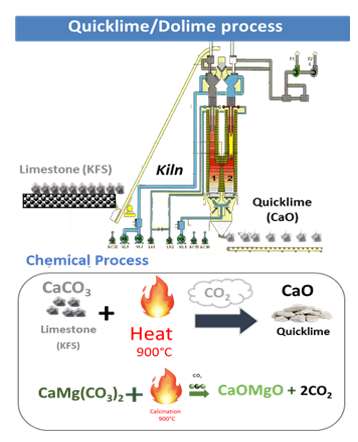
Quicklime, the product Golden Lime makes via calcination of limestone from the Thai Marble owned Khao-Kao quarry Revenue generated from the sale of lime products represents SUTHA’s core income stream, accounting for 82% of total revenue from Sales and Services in the previous fiscal year. Of this amount, 96% was derived from domestic sales and 4% from export markets. The Company serves a broad range of domestic industrial sectors, while export sales were distributed to Bangladesh, Taiwan, Singapore, Korea, the Philippines, Laos, and other countries.
Production volumes remain under pressure due to market conditions characterized by excess supply and limited demand, coupled with intensified competition among numerous producers. The Company’s key business activities and major customers continue to center around lime products, with demand concentrated in the following core industries:
Steel Industry
The steel sector remains the principal consumer of lime and contributes 20% of the Company’s revenue. The industry has shown signs of stabilization and modest recovery following a downturn in 2023 and continued contraction in 2024, largely driven by a slowdown in construction activities. Several domestic steel manufacturers ceased operations in prior years, while the remaining producers continue to face competitive pressures from imported steel and low-quality steel produced locally using induction furnaces.
Although regulatory momentum emerged after the collapse of a large building impacted by the major earthquake in March 2025 prompting authorities to strengthen industrial standards to curb the use of substandard steel these measures have not yet provided sufficient protection for domestic producers against unfair competition from Chinese imports. Despite slight improvements supported by construction projects and automotive manufacturing, the sector continues to face structural challenges from subdued construction demand and persistent oversupply from China.
Construction Industry
The construction sector, targeted for the Company’s CAVA products, has yet to achieve expected performance levels, including sales from the subsidiary. This industry accounted for 15% of total revenue but has been affected by a downturn in the real estate market since the second half of 2024, with no material signs of recovery. Nevertheless, sales of construction stone continue to provide partial support to the Company’s revenue base in this segment.
Chemical Industry
The chemical industry remains an important customer group, contributing 14% of revenue. Growth potential exists due to continued foreign investment in Thailand and the country’s role as a production base for organic chemicals. However, increasing competition has led to downward pressure on selling prices and declining sales volumes.
Sugar Industry
The sugar sector contributed 10% of total revenue and experienced reductions in both volume and selling prices due to competitive pricing pressures within the market. As a result, revenue from this segment declined compared to the previous year.
Export Sales
Export sales represented 4% of total revenue. Export volumes decreased relative to the prior year due to the continued appreciation of the Thai Baht, which adversely impacted the competitiveness of Thai products in international markets.
Dolime The dolime product line, now in its sixth year of continuous production and sales under the Company’s new product development initiative, serves as a substitute material in steel manufacturing to replace imported magnesium. Performance remained below expectations due to the prolonged downturn in the steel industry since 2023. Over the past two years, reduced production levels resulted in significant accumulation of inventory. Moreover, a malfunction in the dolime briquetting machine prevented production of briquetted products, further contributing to inventory turnover delays.
In 2025, these accumulated impacts led to adjustments in product valuation and downward revisions of future value estimates. Nevertheless, capital expenditure for upgrading the briquetting machinery has been approved, including the installation of an additional machine to expand processing capacity and support future production and sales.
Calcium Carbonate
The Company manufactures calcium carbonate from both calcite and marble sources, offering products across high-grade and medium-grade quality levels. High-grade calcium carbonate is produced from calcite using small-scale production capacity, while medium-grade products are manufactured using raw materials sourced from the Khao Ngob quarry operated by the Marble Company. These products collectively form the Ground Calcium Carbonate (GCC) product group.
Following the Company’s investment in GCC production facilities and machinery, product acceptance improved notably during the first half of the year. However, demand subsequently softened due to the impact of the “Trump Tariffs”, which affected customers using GCC to manufacture export-oriented products destined for the United States. As a result, purchase volumes declined.
Limestone aggregates The Company’s crushed stone products, sourced from the Khao Khao quarry of Thai Marble LLC, are used in road construction, flue gas desulfurization processes, and concrete production. While this business contributes to the revenue of Golden Lime Public Company Limited, its impact on EBITDA remains limited, as crushed stone is primarily produced as a by-product from limestone extraction for kiln operations. Nonetheless, this product segment remains a strategic area for generating incremental value and supporting long-term EBITDA growth.
Marble aggregates The marble scrap business, introduced by the Marble Company two years ago, has developed into a small-scale commercial activity that is profitable and contributes positively to the subsidiary’s EBITDA performance.
Marble ornamental stone The decorative marble business is the long-established core business of the Marble Company, with a legacy spanning over 60 years. It remains a stable contributor, representing not less than 9% of the Company’s EBITDA. This business reflects the continuation of traditional Thai architectural craftsmanship and forms a solid foundation supporting the long-term stability of SUTHA Group.
During the past fiscal year, production relied on domestic raw materials from the Khao Ngob quarry the largest marble quarry in Thailand. Finished products comprised both locally manufactured marble and imported marble, complemented by installation services and artisanal craftsmanship. This segment continues to represent a key revenue source for the Thai Marble LLC, a major subsidiary within the SUTHA Group.
Operating Results & Financial Condition
Operating Results & Profitability
Analysis on the operation and financial condition
Operating results and profitability
Sales revenue
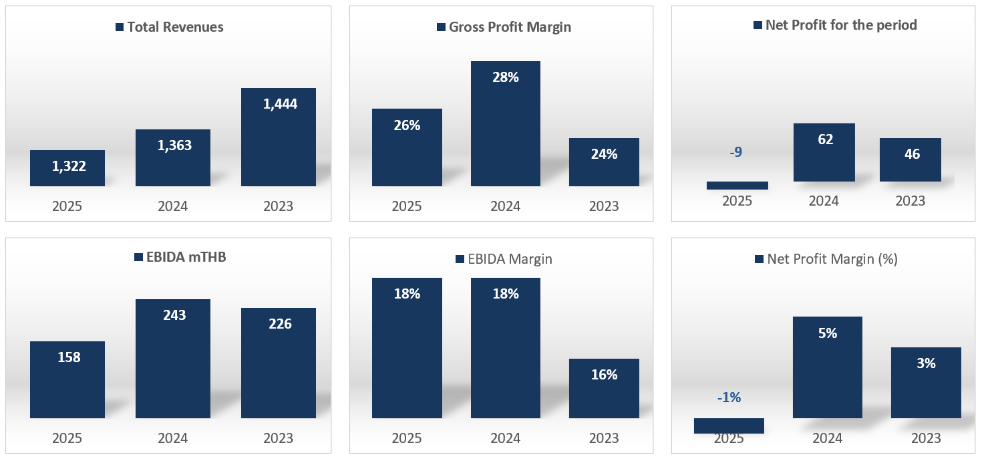
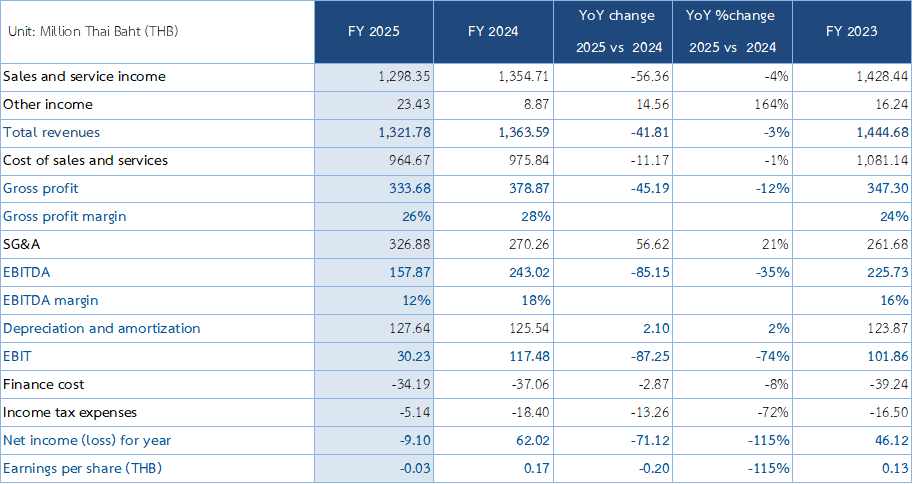
Sales and service income for FY 2025 amounted to THB 1,298.35 million, representing a 4% decrease YoY compared to THB 1,354.71 million in FY 2024. The contraction was primarily driven by continued pricing pressure in a competitive market environment and softer demand from construction-related sectors
Other Income rose significantly mainly due to one-time inventory compensation recognized from a subcontractor in TMC.
Gross profit decreased to THB 333.68 million from THB 378.87 million, resulting in a lower gross profit margin of 26% compared to 28% in FY 2024. The reduction was mainly driven by several exceptional items recognized during the year, including: (i) Restructuring costs related to organizational realignment, (ii)
Allowance for cost reduction to net realizable value (NRV) for certain product categories, and
Reclassification of held-for-sale materials to ensure appropriate inventory valuation.
Excluding these exceptional items, the Company’s normalized gross profit would have improved by approximately THB 46 million, resulting in an adjusted gross profit of about THB 379.68 million. Under this normalized basis, the gross profit margin would rise to approximately 29%, representing an improvement compared to the prior year’s margin of 28% reflecting the underlying strength of core operations.
SG&A expenses increased 21% YoY to THB 326.88 million, driven by provisions for doubtful accounts in both GL and TMC and exceptional items of restructuring costs related to organizational realignment and the Company implemented a new surveyor-based bulk inventory counting policy, designed to enhance efficiency and improve the accuracy of inventory measurement. This transition temporarily increased administrative requirements during the implementation phase but is expected to strengthen bulk inventory control and support more reliable operational reporting going forward.
EBITDA declined to THB 157.87 million, down from THB 243.02 million, reflecting both lower revenue and margin compression during the year.
Finance costs decreased by 8% to THB 34.19 million, reflecting lower interest rates and consistent debt servicing. Net
profit (loss) for the period was THB -9.1 million.
Liquidity & Capital Adequacy
Key factors affecting business operations, aside from competitive pricing strategies by small producers with lower management costs, include the reliance on natural raw materials, which the company secures by owning the limestone quarry concession for production in the lime and mineral processing industry, and oil and fuel price volatility. Additionally, there are risks from climate regulation changes that increase the stringency of measures to reduce greenhouse gas emissions, requiring the industry to find management strategies to keep impacts within acceptable limits.
Asset Management Capability
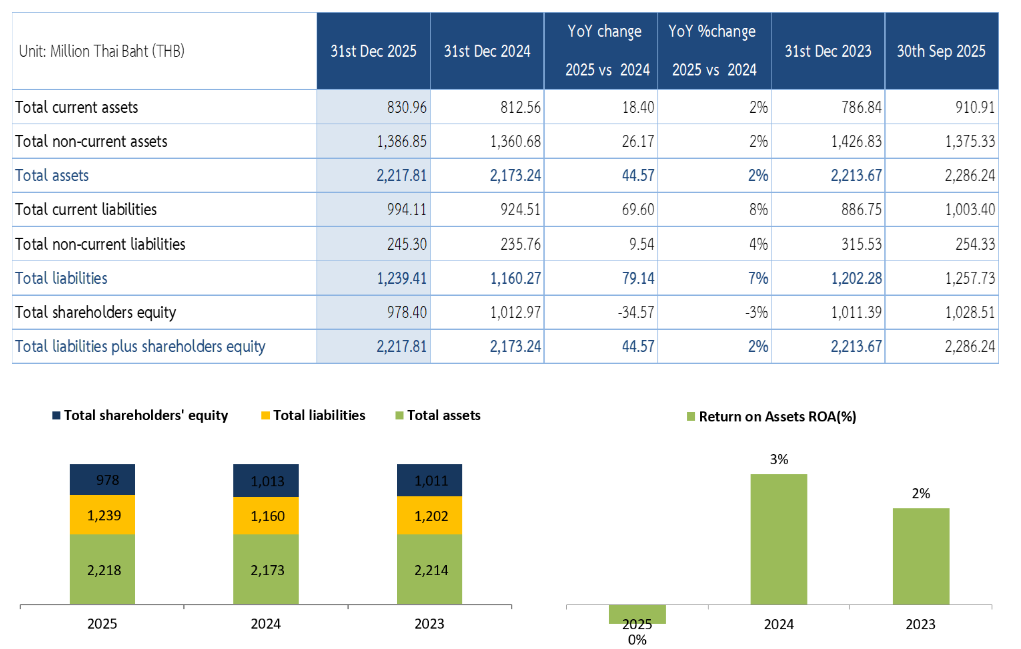
Total assets increased by 2% to THB 2,217.81 million as of 31 December 2025, compared to THB 2,173.24 million at year-end 2024. The growth was supported by both current and non-current assets.
Current assets rose 2% to THB 830.96 million, primarily reflecting higher inventory levels from strategic procurement of petroleum coke fuel to secure supply and optimize production costs.
Non-current assets increased 2% to THB 1,386.85 million, driven mainly by ongoing capital expenditures for capacity enhancement.
Total liabilities increased by 7% to THB 1,239.41 million, up from THB 1,160.27 million in the prior year.
Current liabilities rose 8% to THB 994.11 million, mainly due to short-term borrowings to finance fuel purchases for ongoing operations
Non-current liabilities increased 4% to THB 245.30 million, reflecting long-term financing for expansion projects.
Shareholders’ equity decreased 3% to THB 978.40 million, compared to THB 1,012.97 million in 2024. The decline was primarily driven by the net loss recorded in FY2025.
Debt Obligations & Off-Balance-Sheet Management
See details in Notes to the Financial Statements No. 15–20.
Material & Related-Party Transactions
None. MT transactions and related party transactions conducted in the normal course of business with individuals or entities are disclosed in Section 9.2.
Debt Securities with Financial Ratio Requirements
Debt Securities with Financial Ratio Requirements Issued?
No
Factors That May Affect Financial Condition
Factors or Incidents That May Materially Affect Financial Condition
Key factors affecting business operations, aside from competitive pricing strategies by small producers with lower management costs, include the reliance on natural raw materials, which the company secures by owning the limestone quarry concession for production in the lime and mineral processing industry, and fuel price volatility. Additionally, there are risks from climate regulation changes that increase the stringency of measures to reduce greenhouse gas emissions, requiring the industry to find management strategies to keep impacts within acceptable limits.
Projects or R&D Affecting Future Results
Investment in increasing production capacity of calcium carbonate powder:
To support its growth objectives in supplying diverse products to the country’s core industries, the Company must continue upgrading its production processes to ensure uninterrupted operations. This includes enhancing product processing capabilities for different industrial applications and maintaining 24/7 furnace operations throughout the year. As part of this, scheduled maintenance is required, including a major shutdown every five years to replace refractory bricks and periodic upgrades to control systems to keep pace with evolving technology.
Additionally, the Company has planned capital investments for its electric vehicle program to reduce maintenance costs and promote clean energy usage, with a preliminary budget of over THB 70 million allocated for 2026. All investment decisions will be prioritized based on operational necessity, financial feasibility, available cash flow, and credit facilities supported by financial institutions.